



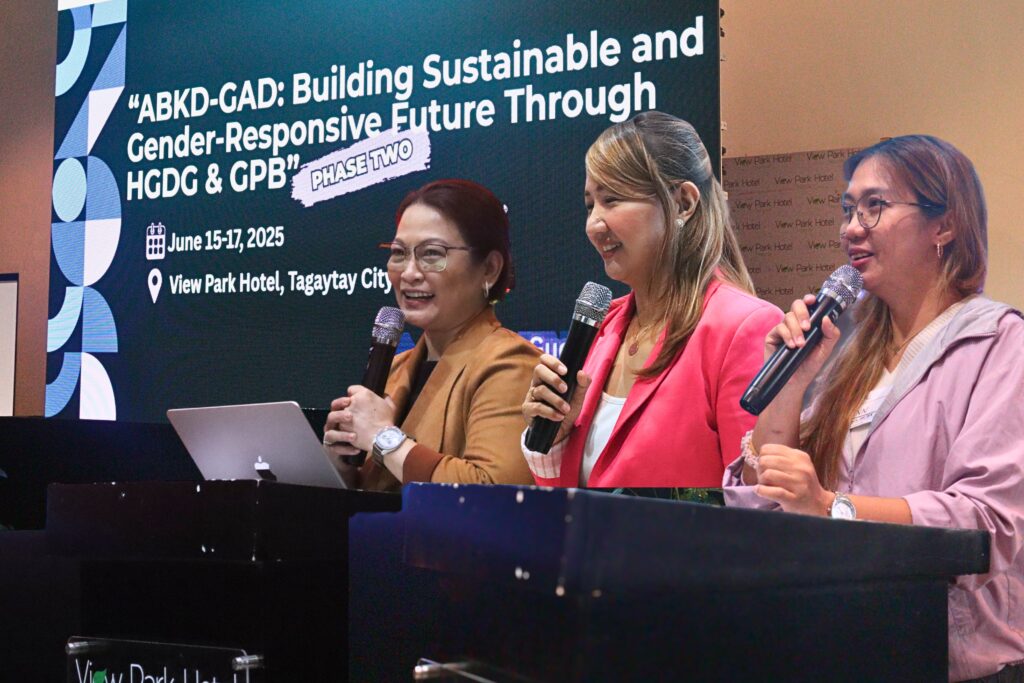
Rizal Technological University (RTU), through the Office of the Vice President for Research, Innovation and Extension Services (OVPRIES) and the Gender Studies and Development Office (GSDO), successfully concluded the second phase of the “ABKD-GAD: Building a Sustainable and Gender-Responsive Future Through HGDG and GPB” training workshop held from June 15 to 17, 2026, at View Park Hotel, Tagaytay City.
The three-day activity brought together university stakeholders to deepen their understanding of gender mainstreaming principles, gender-responsive governance, and the formulation of the 2027 Gender and Development Plan and Budget (GPB), equipping participants with the competencies needed to meaningfully embed GAD frameworks across institutional operations.
The first day opened with sessions on Institutionalizing Gender Equality: Governance, Policy, and Resource Allocation for GAD and the Anti-Sexual Harassment and Safe Spaces Act, providing participants with a grounded understanding of the legal and policy landscape governing gender equality in higher education. These discussions were reinforced through Workshop 1: Case Studies on Sexual Harassment and Safe Spaces, which challenged participants to apply frameworks to real-life institutional scenarios. The day concluded with a GAD Fellowship Night, strengthening the spirit of collaboration and shared advocacy among participants.
The second day featured a session led by guest speaker Dr. Gina A. Opiniano, who examined the intersection of gender equality and academic excellence in her discussion titled “Gender Equality as Academic Excellence: Why GAD is Everyone’s Responsibility?” Her presentation underscored that gender mainstreaming is not merely a compliance requirement but a collective institutional responsibility. The afternoon transitioned to Workshop 2: Drafting the 2027 GPB, in which participants developed gender-responsive budget proposals, which were subsequently presented and critiqued to sharpen planning and resource allocation skills.
On the final day, participants presented the Consolidated Initial Draft of the GPB 2027, reflecting the collective outputs of the workshop sessions. An Environmental Scanning activity further guided participants in assessing institutional needs, opportunities, and priorities to inform future GAD initiatives. The program formally closed with a synthesis of key learnings, awarding of certificates of participation, closing remarks, and a group photo — marking the successful completion of the training.
Through ABKD-GAD Phase 2, RTU reaffirmed its steadfast commitment to advancing gender equality and cultivating a more inclusive, gender-responsive academic community — one grounded in sound policy, strategic resource allocation, and a culture of shared responsibility for institutional transformation.