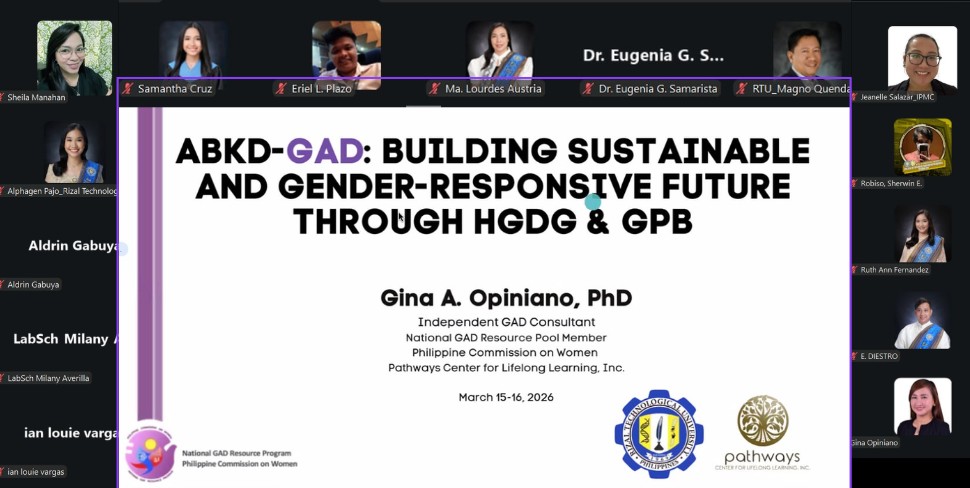


Rizal Technological University (RTU) continues to strengthen its institutional capacity in gender equality and women’s empowerment. Through the Gender and Development Office (GSDO), the training titled “ABKD-GAD: Building Sustainable and Gender-Responsive Future through HGDG & GPB” was conducted via Zoom Teleconferencing on April 15-16, 2026. The event aimed to intensify the university’s efforts to mainstream gender perspectives across its academic and administrative frameworks, ensuring a safe, inclusive, and transformative environment for all Rizalianos.
The program featured a comprehensive series of sessions led by Dr. Gina A. Opiniano, an Independent GAD Consultant and member of the National GAD Resource Pool of the Philippine Commission on Women (PCW). Her discussions emphasized the practical application of the Harmonized Gender and Development Guidelines (HGDG), focusing on their relevance to instruction, research, and extension programs within the university context.
A highlight of the training was the discussion on Gender Analysis (GA) and the Degrees of Integration of Gender Perspective. Dr. Opiniano underscored the importance of transitioning from “Gender Sensitive” projects to “Gender Transformative” initiatives that actively promote shared power, control over resources, and women’s empowerment. The sessions provided a roadmap for identifying gender issues and overcoming obstacles to equality through structured frameworks like the Harvard Analytical Framework and the Gender Mainstreaming and Evaluation Framework (GMEF).
The participants were also allowed to conduct technical evaluations of the GAD Focal Point System (GFPS) functions, focusing on generating sex-disaggregated data and preparing the annual performance-based GAD Plans, Programs, and Budget (GPB).
The training also discussed Ladderized Training on GAD, a strategic progression that builds foundational concepts before moving into advanced gender analysis and resource allocation. By mastering these tools, RTU researchers and administrators are better equipped to ensure that university projects are not only compliant with national mandates but are also high-impact and equitable.
Through institutional training like this, RTU reaffirms its commitment to maintaining a safe, gender-sensitive learning environment for all Rizalianos. As RTU moves forward with its academic- and governance-oriented goals, the community, through GSDO, remains committed to inclusive education.