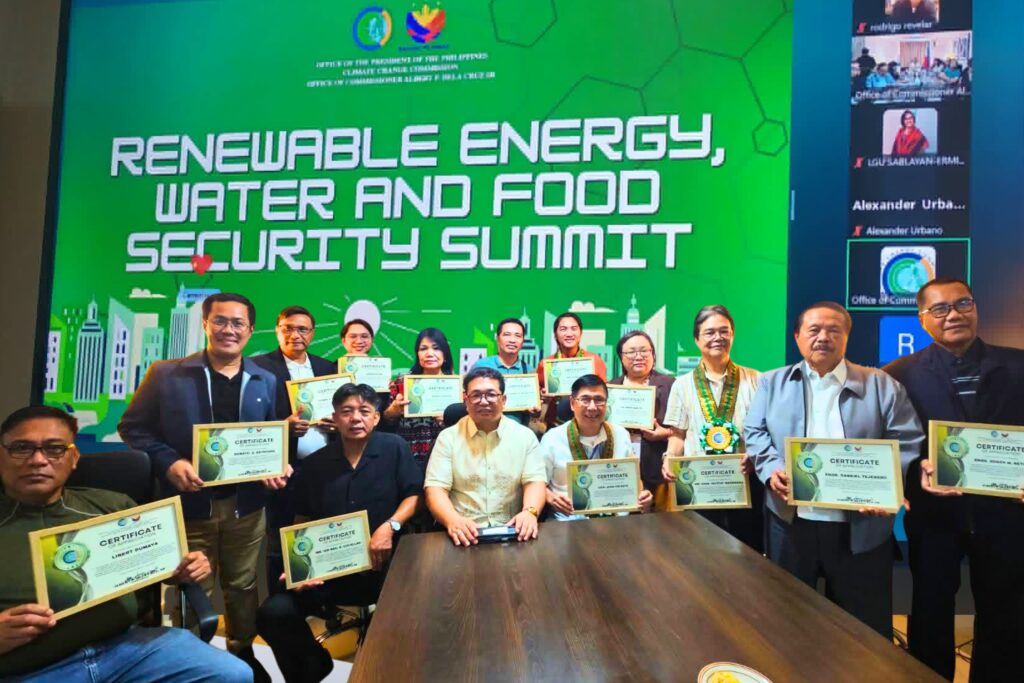


Rizal Technological University (RTU) reaffirmed its commitment to sustainable development and climate resilience through its active participation in the Renewable Energy, Water, and Food Summit organized by the Climate Change Commission (CCC), where the University showcased its innovative climate action initiatives and strengthened its partnership with the national government.
Representing RTU, Assoc. Prof. Donato Z. Estocada, Director of the International Affairs and Linkages Office (IALO), presented the University’s strategic initiatives that contribute to climate adaptation, food security, and sustainable community development. During his presentation, he highlighted RTU’s flagship Farm-to-Food Facility Project in Baras, Rizal, an integrated initiative that promotes sustainable agriculture, food processing, research, innovation, and community empowerment while supporting the country’s climate resilience agenda.
Assoc. Prof. Estocada also emphasized RTU’s continuing commitment to collaborate with the Climate Change Commission in developing science-based and sustainable solutions that address pressing environmental challenges. He underscored the University’s readiness to support national climate initiatives through research, innovation, capacity-building, and international partnerships.
A significant highlight of the summit was the announcement made by Dr. Albert Dela Cruz, CCC Commissioner, who officially welcomed Assoc. Prof. Estocada as a member of the Commission’s Technical Panel. The appointment recognizes his expertise in international collaboration, sustainability, and project development.
Commissioner Dela Cruz likewise announced that Rizal Technological University will work closely with the CCC in the preparation and development of feasibility studies for climate-responsive and sustainability-driven projects, further strengthening the University’s role as a trusted academic partner in advancing the country’s climate agenda.
Meanwhile, Instr. Jason Kalaw, RTU Climate Change Focal Person and Head of the University’s Astronomy Department, shared RTU’s initiatives in promoting science education and public engagement through astronomy. He presented RTU’s commitment to support the upcoming National Jamboree in Pangasinan in November 2026 by providing access to the University’s astronomical equipment, allowing participants to experience astronomy-based educational activities that foster environmental awareness, scientific curiosity, and appreciation of the natural world.
RTU’s participation in the summit reflects its unwavering dedication to advancing the Sustainable Development Goals (SDGs), particularly those related to climate action, clean energy, sustainable communities, food security, and quality education. Through strengthened collaborations with the Climate Change Commission and other national stakeholders, the University continues to position itself as a leading institution in sustainability, research, innovation, and climate-responsive development.
The summit served as an important platform for government agencies, higher education institutions, industry leaders, and development partners to exchange innovative solutions and forge meaningful collaborations toward building a more resilient, sustainable, and climate-smart Philippines. RTU remains steadfast in its mission of transforming knowledge into action by creating impactful solutions that benefit communities and contribute to national and global sustainability efforts.