


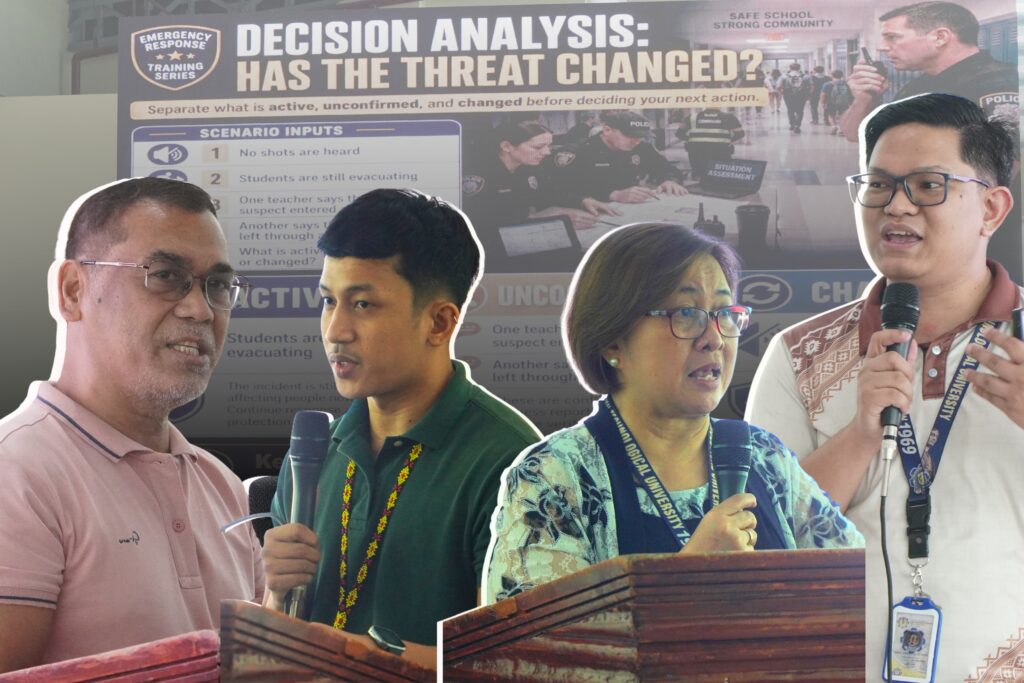
The Safety, Security, and Disaster Risk Reduction Management Unit (SSDRRMU), under the headship of Instr. Jayson Denaga, of Rizal Technological University (RTU) led the faculty members and administrative employees in the orientation on how to respond during emergencies and the presence of threats in a school setting, particularly in RTU. The two-day orientation also served as an orientation on the newly established Active Shooter Emergency Response and Threat Management System (ASERTMS).
Held on October 21 and 22, the initiative featured extensive discussions designed to elaborate on behavioral indicators of probable perpetrators, threat identification, response protocols, crisis management, first aid, and practical simulations. The discussions and practical exercises equipped the participating faculty members and administrative personnel with critical knowledge and capabilities in preventing and responding to threats and minimizing risks and casualties.
The event was also supported by the University President, Dr. Ma. Eugenia M. Yangco, who gave a Message of Support for the ASERTMS initiative. She shared her gratitude for the efforts of the SSDRRMU and the Administrative Services Management Office, led by Dr. Isabel Dizon, in ensuring that the Rizaliano community remains safe through information campaigns and practical implementations. Dr. Yangco also emphasized the importance of the orientation in keeping the community informed and prepared for any threat or emergency that may arise at any time within the campus.
Divided into 10 learning modules, the discussions were led and presented by RTU’s in-house emergency response and disaster management experts.
The morning sessions of the first day were led by Civil Security Officer Karlo A. Catindig, who discussed Modules 1-4, outlining the definitions and concepts of threats, behavioral indicators of probable perpetrators, identification of threats, intelligence gathering, law enforcement protocols, and how to institutionalize security policies and emergency action plans. Mr. Katindig masterfully discussed identification strategies crucial to preventing threats and emergencies, measures and practices to effectively complement law enforcement response tactics, and RTU’s ongoing plans and drafted policies designed to strengthen the University’s capabilities in handling perpetrated threats.
Instr. Denaga continued the discussions with the subsequent two modules, introducing the local crisis management teams and support system for the university, and sharing the best approaches in civilian response and survival strategies. As head of RTU’s security group, Instr. Denaga’s insights in crowd control and crisis management proved significant in the discussions.
The last four modules were discussed by AO. Emmanuel Taruc, Head of the General Services Unit and a Licensed Nurse. His discussions focused on delivering first aid measures, caring for casualties, basic triage, open wound management, and securing patient respiration. To effectively exhibit the necessary skills and steps in these critical actions, AO. Taruc expertly demonstrated practical applications of his discussions.
Bringing the discussions into practice, the last module was facilitated by AO. Taruc focused on practical simulations and scenario analysis. The participants were separated into small groups to strategically encourage discussions on how to effectively implement the discussed protocols and strategies. The results of the focus group discussions were also presented as a conclusion to the crucial knowledge-sharing sessions and workshops.
As the dangers of active shooter emergencies remain a concerning issue across the nation, RTU ramps up its capacity to prevent, respond, and manage threats that put the whole community at risk. Through the ASERTMS Orientation, the SDRRMU and the University ensure that the security policies remain responsive to the current needs of the community.