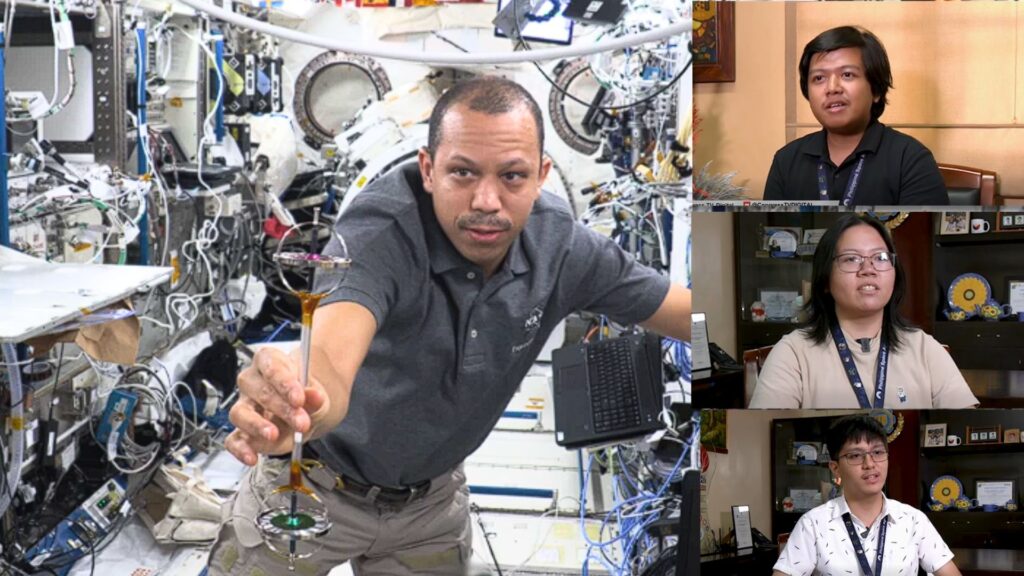


Bachelor of Science in Astronomy students from Rizal Technological University (RTU) made a historic achievement for the Rizaliano community by having a National Aeronautics and Space Administration (NASA) astronaut on the International Space Station (ISS), who successfully conducted the Rizaliano-designed Double Gyroscope Experiment on March 24, 2026.
The Double Gyroscope experiment, designed by Christopher Tumamac, Rose Ann B. Cezar, and Ryan Andrew R. Doña, now third-year students, was chosen as one of the 11 international finalists of last year’s Asian Try Zero-G (ATZG) competition. The ATZG competition, organized by the Japan Aerospace Exploration Agency (JAXA) in collaboration with the Philippine Space Agency (PhilSA), selects creative microgravity experiment submissions from youth and young scientists in the Asia-Pacific region to be conducted by astronauts aboard the Kibo module on the ISS.
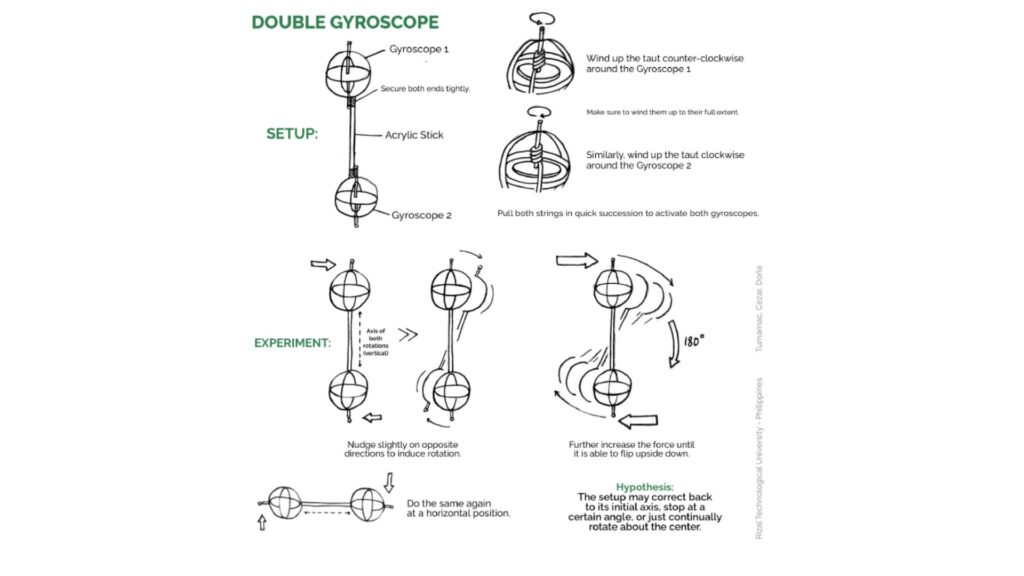
The team of Rizalianos hypothesized that when two spinning devices, or gyroscopes, placed at opposite ends of a stick spin in opposite directions with equal parameters, the motion between the devices may cancel out, resulting in stable motion or no motion in the apparatus or system. This experiment shows how the gyroscopes’ motion behaved in zero-gravity environments. The students also hypothesized that when both gyroscopes spin in the same direction, the combined motion may make the system more stable and resistant to disturbances.
NASA Astronaut Christopher Williams, aboard the ISS Kibo module, repeated the tests to observe the gyroscopes’ motion in zero gravity.
By comparing the gyroscopes’ movements under various conditions, the Double Gyroscope experiment illustrates the effects of spinning motion on stability in zero-gravity environments. Interestingly, the experimental results aligned with the students’ hypotheses.
Prior to the live performance of the experiment, Doña and Tumamac once again presented their experiment proposal at the JAXA Tsukuba Space Center. Their team will present the results of the experiment at the 2025 ATZG wrap-up session, to be held later this year.
The actual performance of the experiment may be viewed at the official YouTube channel of PhilSA through this link: https://www.youtube.com/watch?v=ZnacZuUJF4s