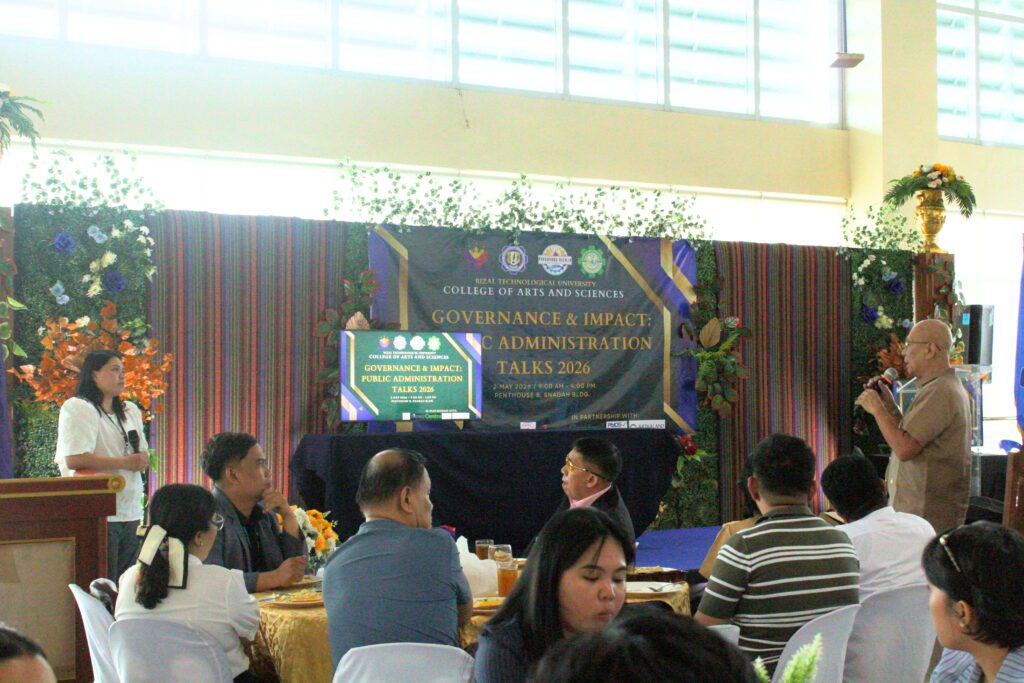


In a historic milestone for Rizal Technological University (RTU), the College of Arts and Sciences (CAS) recently launched “Governance and Impact: Public Administration Talks 2026”, its inaugural Public Administration Graduate Program convocation. The event, which drew nearly 200 participants, served as a high-level forum for redefining leadership, moving beyond cold bureaucratic theory to position public service as a vital convergence of resource management, urban resilience, and legislative action.
The proceedings were anchored by a powerful endorsement from University President Dr. Ma. Eugenia M. Yangco, who highlighted the event’s role in institutional growth. “I commend the organizers for mounting this significant academic activity that provides a meaningful platform for learning, dialogue, and engagement on contemporary governance concerns,” Dr. Yangco stated. “Initiatives such as this strengthen our commitment to developing competent, ethical, and responsive public servants. This gathering is especially noteworthy as it marks the first major academic event for our Public Administration students in the university. It is a strong step forward in building a vibrant academic community that is engaged, informed, and responsive to the needs of society.”
This sentiment was echoed by the presence of key university leaders, including Dr. Kristine Y. Opulencia, Vice President for Academic and Student Affairs; Dr. Jeremiah V. Pacer, Dean of CAS; and Dr. Helen Mercedes C. Asturias, CAS Associate Dean.
The seminar featured three distinguished pillars of public service, beginning with Dr. William Dar, the former Secretary of Agriculture. In his talk, “Food on the Table: Why Agriculture is the Backbone of Philippine Politics,” Dr. Dar grounded the seminar in the fundamental reality that no nation can achieve stable democracy while its citizens are hungry. He argued that agriculture is the “silent engine” of political stability and warned that neglecting farmers and fisherfolk creates aftershocks across all levels of public service. For Dr. Dar, the ultimate goal of modern governance is to ensure that food security remains the priority and that no Filipino is left behind by modernization.
Shifting the focus from rural foundations to urban survival, USec. Frisco San Juan Jr., MMDA Deputy Chairman and former Rizal Provincial Vice Governor, delivered a masterclass titled “Architect of Urban Resilience: Masterclass in Local Government and Regional Administration.” He addressed the public administrator’s role as a protector in an era of rapid urbanization and climate change. San Juan Jr. challenged the audience to move away from “reactionary disaster response” and toward “proactive regional planning.” He emphasized that infrastructure must be engineered to withstand both the forces of nature and the logistical pressures of a growing population.
The seminar concluded with an intellectually rigorous look at the future of policy, presented by Hon. Mikhail San Juan, who delivered “Theory and Practice in Public Administration: The Praxis of Youth Governance and Legislative Impact.” While previous speakers focused on the “what” of governance, Hon. Mikhail explored the “how” and “who,” specifically through the lens of “praxis”—the application of academic theory to social change. He demonstrated how the ideas of the younger generation can be successfully channeled into legislative action, urging students to use their education as a bridge from the classroom to the Capitol while maintaining a steadfast commitment to social justice. This provided a holistic vision of modern service.
From the essential soil of Dr. Dar’s agriculture to the structural blueprints of USec. San Juan Jr. and the legislative praxis of Hon. Mikhail San Juan reinforced a singular truth: public administration is only successful if it translates into meaningful betterment for the citizenry.
As RTU’s first Public Administration convocation, the event set a high standard for future academic engagement, proving that impact is indeed the heart of good governance and transformative education.