


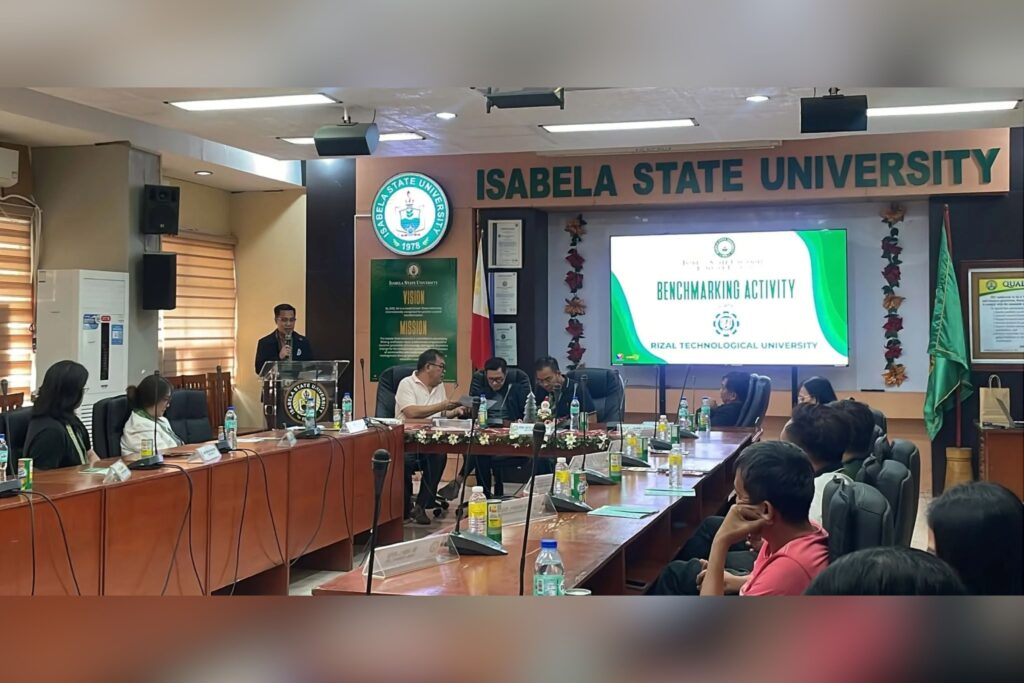
Rizal Technological University (RTU) conducted an exploratory meeting and benchmarking visit to Isabela State University (ISU) to learn from the latter’s institutional best practices in research and development (R&D), research grant management, research and development centers, and internationalization programs and initiatives.
The RTU delegation was led by Assoc. Prof. Donato Z. Estocada, Director of the International Affairs and Linkages Office (IALO), together with representatives from the Research Management Office and the Inclusive Education Office. The composition of the delegation reflected RTU’s integrated approach to institutional development, recognizing the importance of strengthening research, internationalization, and inclusive education in advancing the University’s strategic goals.
The visit provided RTU with an opportunity to gain valuable insights into ISU’s institutional strategies, management systems, and innovative approaches to strengthening research productivity, enhancing research support mechanisms, and expanding international academic partnerships. Through discussions and the exchange of experiences, RTU explored practices that may be adapted and integrated into its institutional development initiatives, particularly in advancing its research capabilities and internationalization agenda.
As part of its continuing efforts to strengthen its technology transfer capabilities, RTU’s delegation also visited ISU’s Technology Transfer Hub and other research centers.
The visit provided the RTU delegation with an opportunity to gain firsthand insights into ISU’s institutional best practices in managing research facilities, promoting innovation, facilitating technology transfer, and translating research outputs into practical applications that address industry and community needs.
Through facility visits and knowledge-sharing discussions, the RTU team explored ISU’s approaches to research management, technology commercialization, intellectual property development, innovation support systems, and the utilization of research outputs. Particular attention was given to the mechanisms that bridge academic research with industry applications, community development, and sustainable innovation.
A significant highlight of the engagement was the signing of a Memorandum of Understanding (MOU) between RTU and ISU, establishing a framework for institutional cooperation in academic instruction, scientific research and development, human resource capability building, student training, and community engagement.
The agreement opens opportunities for faculty and staff mobility, joint research projects, collaborative applications for research grants, student internships and work immersion, and the organization of academic conferences, workshops, seminars, and training activities. It also provides avenues for curriculum development, resource and facility sharing, technology transfer, community outreach, and sustainable development initiatives, subject to mutual agreement and applicable institutional requirements.
The engagement marks another important milestone in RTU’s continuing efforts to strengthen its institutional capacities through benchmarking, strategic collaboration, and knowledge exchange. It underscores the University’s commitment to learning from leading higher education institutions, enhancing its research and innovation ecosystem, promoting inclusive education, and building meaningful partnerships that create opportunities for its faculty, staff, and students.
Through initiatives such as this, Pandayang Rizalia continues to advance its aspiration of becoming a Smart and Transnational University—strengthening its research foundations, championing inclusive education, expanding its global connections, and transforming partnerships into impactful institutional outcomes.