



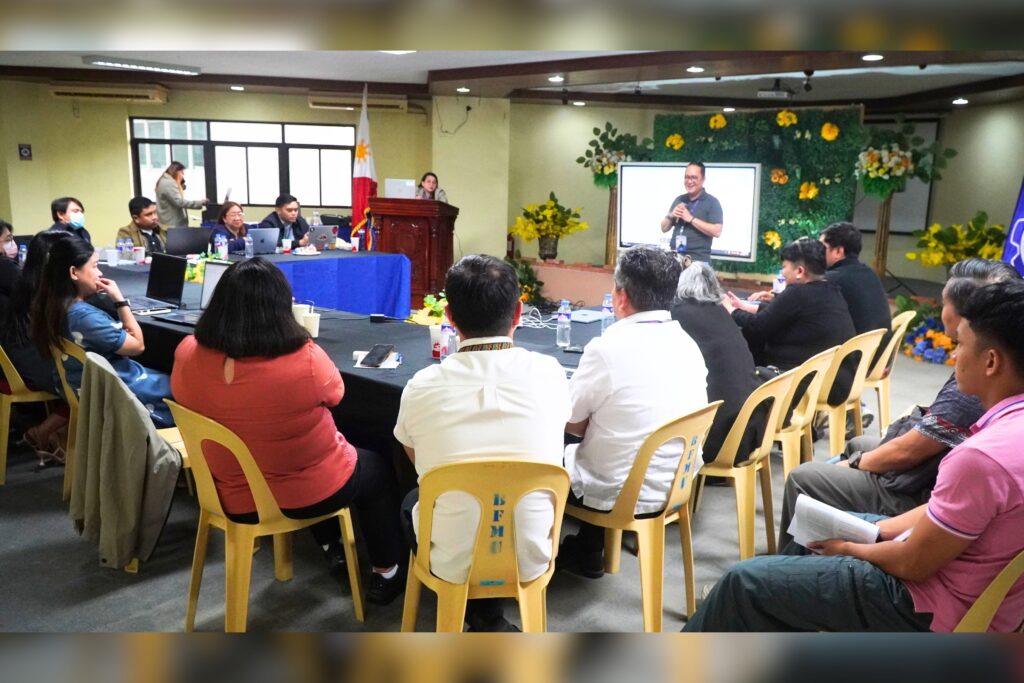
Rizal Technological University (RTU) welcomed representatives from various national agencies, local government, and the University of the Philippines Resilience Institute (UPRI) on October 1, 2026, as the university presented its Land Use Development and Infrastructure Plan (LUDIP) for 2022-2032.
These representations formed the Commission on Higher Education-National Capital Region (CHED-NCR) Technical Working Group for LUDIP (NCR LUDIP TWG), a group tasked with evaluating and assessing the LUDIP of State Universities and Colleges (SUCs) within NCR. The NCR LUDIP TWG was led by Mr. Victorino Datuin from CHED-NCR, who served as the chairperson of the TWG. With him, the members of the NCR LUDIP TWG were:
- Ms. Kristine Jay C. Eslabra-Dojeno from the Department of Budget and Management-NCR
- EnP. Adrian Kirby E. Dacug from the Department of Environment and Natural Resources-NCR
- Ar. Kaseelyn Redublado from the Department of Human Settlements and Urban Development
- Engr. Aimah C. Busok from the Department of Public Works and Highways
- Mr. Rosauro De Leon from the Department of Economy, Planning, and Development
- EnP. Ibylou B. Golla from the Philippine Institute of Environmental Planners
- Ms. April Dawn F. Tegelan from UPRI
- Ms. Ada Beatrice Reyes from UPRI
- Ar. John Anthony Arlegui from the Local Government of Mandaluyong City
- Engr. Jan Ahmel Alimuin from the Local Government of Mandaluyong City
- Ar. Alvin Arriola from the Local Government of Pasig City
Welcoming the NCR LUDIP TWG on behalf of the Rizaliano community was Dr. Salvacion J. Pachejo, Vice President for Planning, Quality Assurance, and Strategic Initiatives, who expressed gratitude for the group’s presence. She highlighted that the evaluation is a reflection of RTU’s commitment, not just in satisfying requirements, but in fostering partnerships toward sustainable, inclusive, and responsive land use and infrastructure planning.
The evaluation of the university’s LUDIP commenced with Engr. Niño Augusto S. Curpos, Director of RTU’s Project Management Services Office, presenting a comprehensive summary of the revised RTU LUDIP for 2022-2032. Included in the plan are the campuses of RTU in Mandaluyong and Pasig, along with the university property in Baras, Rizal. The plan also outlined the infrastructural needs of the Rizaliano community, including the ongoing construction of the buildings for student dormitories and the university library. Engr. Curpos also highlighted how the Baras property can provide prime opportunities for RTU in advancing its research and development capabilities.
After the presentation, the working group, accompanied by RTU’s own LUDIP TWG led by Engr. Corleto R. Bravo, inspected the ongoing infrastructure projects in the Mandaluyong campus. The NCR LUDIG TWG witnessed firsthand the progress of the university library building and the planned location where the dormitories will be situated.
The post-evaluation conference opened the floor for clarifications on the reported information and the NCR LUDIP TWG’s recommendations on how to enhance RTU’s planning and landscaping to better serve the community and create improved infrastructure plans that respond well to student needs and requirements of the academic activities offered by the university.
Many of the recommendations focused on infrastructure resiliency, with the UPRI representatives recommending the use of UP-developed hazard assessment tools to improve emergency preparedness aspects of RTU’s LUDIP. They also emphasized that hazard assessment should not be limited to the immediate vicinity of the campuses but should include surrounding environments. EnP. Golla supported this recommendation by suggesting that a comprehensive plan for human ingress and egress during emergencies be laid out.
Dr. Ryan Manuel Guido, a member of RTU LUDIP TWG, shared that the university has ongoing research initiatives such as earthquake evaluation studies that may contribute to RTU’s infrastructure planning. He highlighted that research studies are underway to support campus resiliency. Engr. Bravo also clarified that the new buildings of RTU Mandaluyong are equipped with earthquake-resilient materials, assuring the conference that the buildings on the campus are safe.
Mr. Datuin, Ms. Eslabra-Dojeno, and Engr. Busok shared tips on how to secure proper funding and budget allocations for RTU’s infrastructure plans by ensuring that the submitted proposals are compliant with the government’s standards and are well justified through detailed planning.
The LUDIP evaluation conference ended on a positive note as both RTU and the NCR LUDIP TWG both expressed their gratitude and commitment to strengthening the state university’s infrastructure plan and improving the use of its land.