


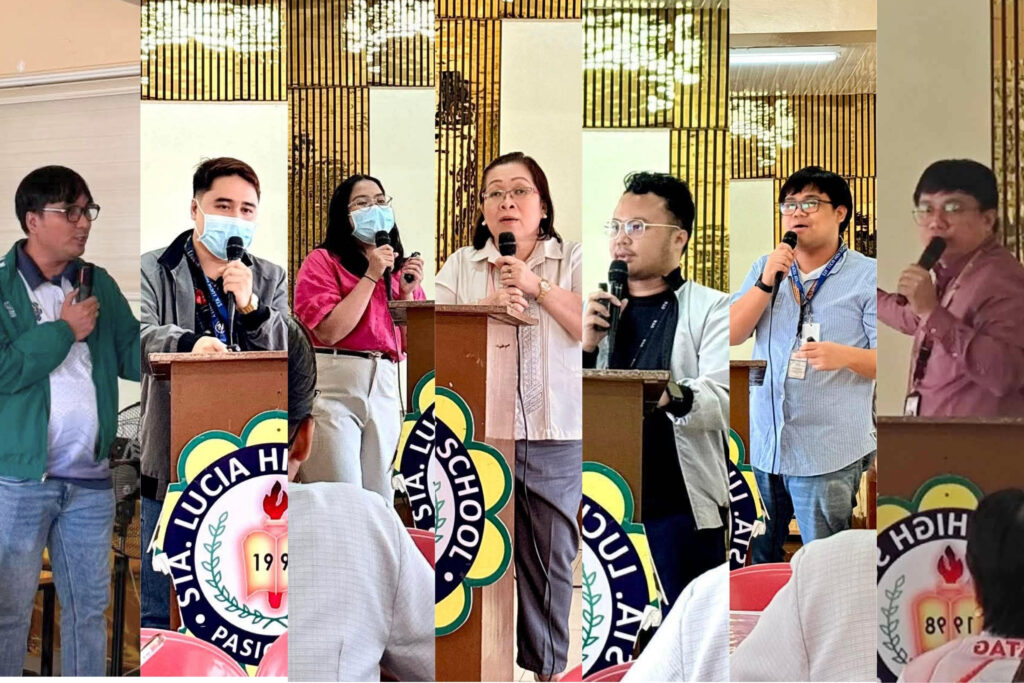
The Social Studies Department of the College of Education (CED) of Rizal Technological University successfully conducted Project DECIPHER: Driving Excellence through Capacity-Building, Innovation, and Publication of High-Quality Evidence-Based Research, a three-day program aimed at strengthening the research skills of educators at Sta. Lucia High School from July 22 to 24, 2026.
The initiative sought to foster a culture of evidence-based practice and professional development: Dr. Lorna Rodriguez, Principal of Sta. Lucia High School, opened the program, encouraging participants to embrace research for educational improvement and professional growth. The program’s success was supported by the coordination efforts of Ma’am Lorna Mansanido and Ma’am Jo Kristina Olladas, alongside Assistant Principal Ma’am Lysette Caruz.
The program featured a series of lectures delivered by distinguished resource speakers who guided participants through the various stages of the research process. Instr. Dexter O. Andal emphasized the vital role of research in evidence-based practice, educational improvement, and institutional decision-making, highlighting the importance of using reliable data and systematic investigation to inform educational policies and practices. Kate Azucena discussed the importance of formulating clear research questions and conducting a comprehensive review of related literature. She explained that well-defined research questions provide direction to a study, while a strong literature review establishes its significance, identifies research gaps, and situates the inquiry within existing knowledge.
Meanwhile, Instr. Zernan E. Gumban Jr. provided practical guidance on proper data collection and management, emphasizing the need for accuracy and the responsible handling of research data. He also reminded participants to critically verify information generated through artificial intelligence, noting that AI-produced content may contain inaccurate or fabricated information if left unchecked. Complementing this discussion, Instr. James Lawrence Gutierrez highlighted the principles of research ethics, data privacy, and research integrity, underscoring researchers’ responsibility to protect participants, acknowledge sources, and critically evaluate AI-generated outputs before incorporating them into academic work.
The program also explored the journey from research writing to scholarly publication through a session facilitated by Dr. Irene G. Ambida. She discussed the standard formats and structures of research manuscripts and the publication process, from journal submission to peer review and publication, and introduced the Department of Education’s Basic Education Research Fund (BERF) as a valuable support mechanism for teacher-researchers. She further demonstrated how research titles can be refined to improve clarity, relevance, and alignment with research objectives while emphasizing the characteristics of publishable research and guiding participants in identifying reputable academic journals to avoid predatory publications. To inspire participants, Dr. Ambida presented a successful extension program that evolved into a publishable research article, illustrating how community engagement initiatives can contribute to both educational practice and scholarly knowledge.
Further enriching the program, Dr. Melvin N. Ambida discussed the importance of analyzing, interpreting, presenting, and utilizing research findings effectively. He emphasized that research achieves its greatest impact when findings are transformed into practical recommendations, instructional innovations, institutional policies, and evidence-based interventions that benefit schools and communities.
Complementing this discussion, Dr. Samuel A. Balbin guided participants in mapping research agendas and identifying research topics that address actual school needs and institutional priorities. He encouraged educators to pursue studies that are relevant, feasible, ethical, and capable of contributing meaningful solutions to educational challenges while aligning their work with broader educational research priorities.
Through Project DECIPHER, Rizal Technological University reaffirmed its commitment to strengthening educators’ research capabilities and fostering a culture of evidence-based practice. More than a series of lectures, the initiative empowered educators to transform research into meaningful action that improves teaching, informs institutional decision-making, and contributes to the continuous advancement of educational quality and learner outcomes.