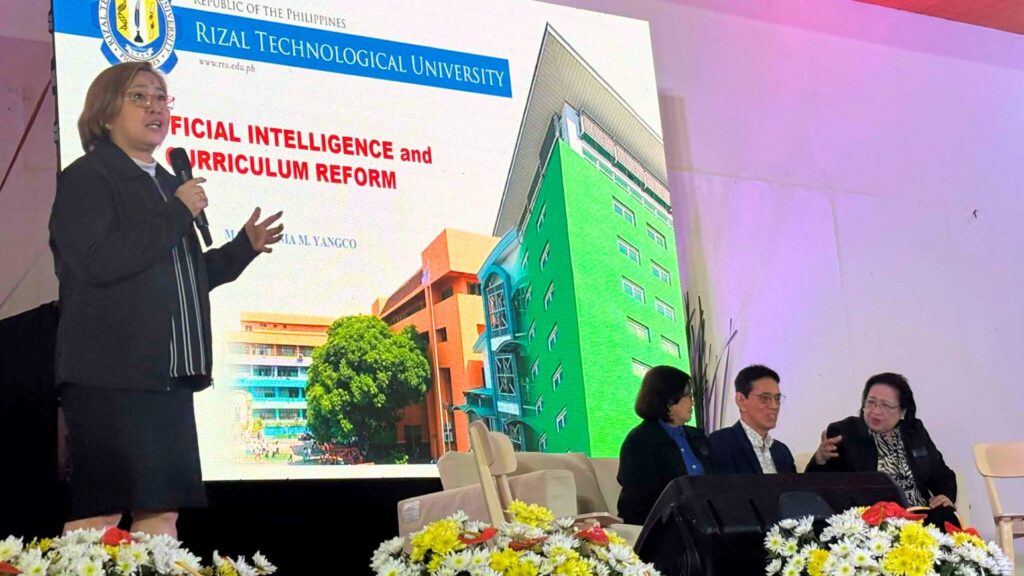


During the 2026 TECHREVEd Conference of the Philippine Schools, Universities, and Colleges Computer Education and Systems Society (PSUCCESS) held at Bulwagang Balagtas, Polytechnic University of the Philippines on February 18-20, key academic leaders from Rizal Technological University (RTU) played active roles in high-level discussions on artificial intelligence and national development.
A highlight of the conference was the plenary panel discussion on the societal impact of AI, jobs, skills, and the future workforce. Dr. Ma. Eugenia M. Yangco, RTU President, served as one of the panelists representing the academe sector. In her intervention, Dr. Yangco highlighted the responsibility of higher education institutions to lead curriculum reform, institutional capacity-building, and the integration of ethical AI. She emphasized that universities must proactively craft policies that balance innovation with inclusivity, accountability, and human-centered development.
Joining her in the panel were Dr. Victoria C. Naval, representing the government on policy readiness, and Mr. Carlos Manuel of the Philippine Computer Society, representing industry perspectives on skills demand and workforce alignment. Together, the panelists provided a multi-sectoral view of how AI is reshaping education systems and labor markets, highlighting the need for stronger collaboration between government, industry, and academe.
The session was moderated by Assoc. Prof. Donato Z. Estocada, Director of RTU International Affairs and Linkages (IALO). Through structured and strategic facilitation, Assoc. Prof. Estocada steered the discussion toward actionable insights, synthesizing panelists’ perspectives and engaging the audience in critical reflection on AI governance and educational readiness.
Complementing the plenary engagement, Dr. Samuel A. Balbin, Associate Dean of RTU College of Education, facilitated a focused group workshop on crafting institutional AI policy frameworks. The workshop helped participants develop key principles grounded in ethics, transparency, inclusivity, data privacy, and sustainable implementation. By turning broad ideas into practical policy directions, Dr. Balbin’s session helped the conference achieve its goal of creating clear institutional paths for responsible AI adoption.
The engaging participation of RTU officials, including Dr. Yangco, upholds the University’s commitment to enhancing education through innovative technology and collaborative partnerships. As a leading institution in technological education, RTU’s role in the panel discussions extends beyond Rizalianos’ stake in digital education and also to the Filipino people.