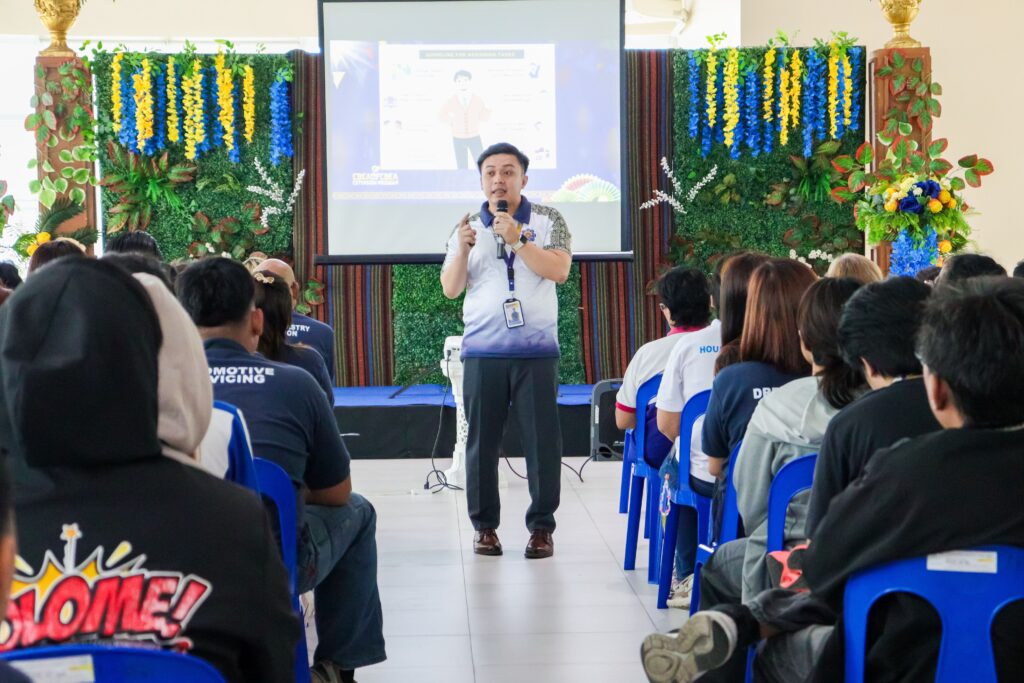


In its continuing commitment to community empowerment and sustainable livelihood development, the College of Business, Entrepreneurship, and Accountancy (CBEA) of Rizal Technological University (RTU), through the Extension and Community Services Office (ECSO), successfully conducted Phase 1: Capability Building of the extension program titled “CBEA of CBEA: Community Business Education and Application of the College of Business, Entrepreneurship, and Accountancy” on June 2–3, 2026 at the Penthouse B, SNAGAH Building, RTU Mandaluyong Campus.
The two-day capability-building activity was conducted in partnership with the Mandaluyong Manpower Technical-Vocational Training Center (MMTVTC) and was attended by 130 student trainees and employees of the institution. The program aimed to equip participants with essential entrepreneurial knowledge and business management skills that would enable them to transform their technical competencies into sustainable income-generating ventures.
The CBEA of CBEA program was conceptualized in response to the persistent challenges faced by Technical-Vocational Education and Training (TVET) graduates, particularly those enrolled in National Certificate (NC) programs. While many possess valuable technical skills, they often encounter limited employment opportunities and difficulties in establishing sustainable livelihoods. A considerable number also seek employment overseas and later face reintegration challenges upon returning to the country. These realities highlighted the need for an extension initiative that not only develops technical competencies but also strengthens entrepreneurial capabilities.
Anchored on business creation and community empowerment, the program seeks to provide participants with a structured pathway toward entrepreneurship through business ideation, validation, and startup development. Ultimately, the initiative aims to empower beneficiaries to become job creators rather than job seekers, contributing to local economic growth and community development.
Messages of support emphasized the importance of entrepreneurship education in promoting economic resilience and self-sufficiency among community members. Participants were likewise oriented on the objectives of the extension program and completed a pre-test to assess their baseline knowledge and understanding of entrepreneurship and business concepts.
The first day of the training focused on developing participants’ foundational understanding of entrepreneurship and business management. Faculty members from various departments of the College of Business, Entrepreneurship, and Accountancy served as resource speakers and facilitators.
During Session 1: Introduction to Business and Entrepreneurship, participants were introduced to the fundamentals of entrepreneurship, business opportunities, and enterprise development. Discussions focused on identifying business ideas aligned with participants’ National Certificate (NC) qualifications and understanding the importance of business planning as a roadmap toward entrepreneurial success.
This was followed by Session 2: Basic Marketing, where participants learned how to identify customers, determine target markets, and apply the Marketing Mix or the 4Ps (Product, Price, Place, and Promotion). The session also highlighted the strategic use of social media platforms in promoting products and services and reaching potential customers in today’s digital environment.
In Session 3: Basic Financial Planning, participants gained practical knowledge on startup costs, budgeting, sources of capital, and simple profit computation. The session underscored the importance of sound financial planning in ensuring the sustainability and growth of a business venture.
The final session of the day, Basic Accounting, introduced participants to fundamental accounting concepts, including recording income and expenses, maintaining simple bookkeeping records, and understanding the importance of accurate financial documentation in managing business operations.
The second day of the capability-building program focused on operational and managerial competencies essential for sustaining a business enterprise.
Through Session 5: Basic Business Operations, participants learned how to effectively manage daily business activities, streamline workflows, and establish productive relationships with suppliers. The session emphasized efficiency, resource management, and operational planning as key elements of business success.
Session 6: Office Administration provided participants with practical knowledge on record-keeping, documentation, filing systems, and office procedures. These skills were presented as essential tools for maintaining organization, accountability, and professionalism in business operations.
The discussion on Human Resource Management enabled participants to appreciate the importance of managing people within a business setting. Topics included assigning tasks and responsibilities, fostering teamwork, and promoting effective communication and coordination in the workplace.
The final learning session focused on Business Registration, Legal Requirements, and Compliance. Participants were guided through the processes involved in registering a business with the Department of Trade and Industry (DTI), Securities and Exchange Commission (SEC), Bureau of Internal Revenue (BIR), and local government units. The session also discussed permits, licenses, and the legal responsibilities of business owners in maintaining compliant and sustainable enterprises.
The successful conduct of CBEA of CBEA Phase 1 provided the 130 participants with a strong foundation in entrepreneurship, marketing, finance, accounting, operations management, office administration, human resource management, and legal compliance. More importantly, the training enabled participants to recognize the entrepreneurial potential of their technical skills and inspired them to explore business opportunities within their respective fields.
As the first phase of the extension framework, the activity marks a significant step toward achieving the program’s long-term goals of developing entrepreneurial competencies, facilitating enterprise creation, and promoting sustainable livelihood opportunities among TVET graduates and community beneficiaries.
Through meaningful partnerships and responsive extension initiatives, Rizal Technological University continues to fulfill its commitment to community development and inclusive economic growth. With the successful completion of Phase 1, participants are now better prepared to advance to the succeeding phases of the program, where they will further develop, validate, and eventually implement their enterprise ideas toward becoming successful entrepreneurs and contributors to local economic development.