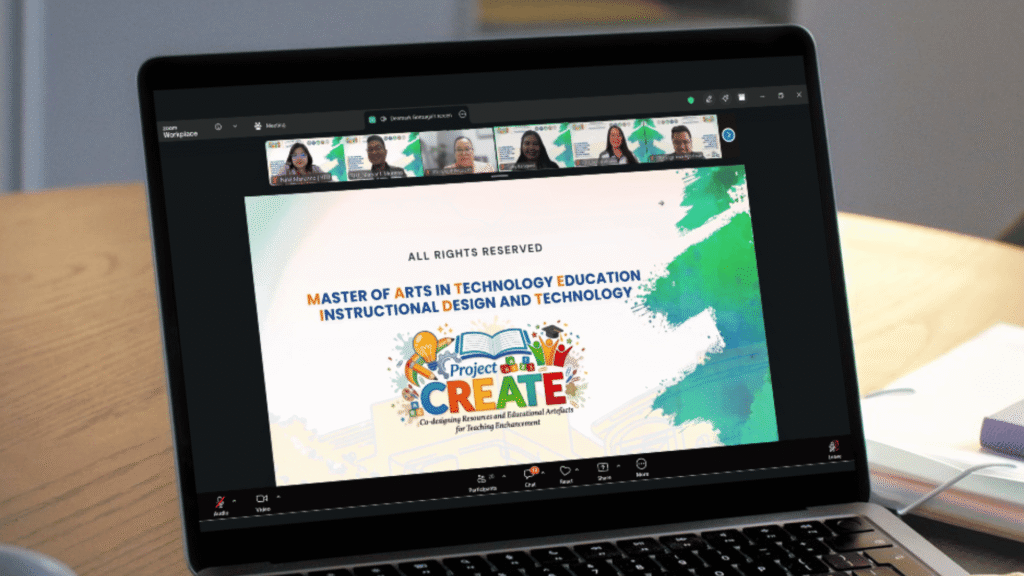


Championing the future of human-centered education, the Rizal Technological University (RTU) College of Education-Graduate Program (CED-GP), through its Master of Arts in Technology Education Major in Instructional Design and Technology (MATE-IDT), successfully launched Phase 1 of its highly anticipated extension program, Project CREATE 1.0: Co-designing Resources and Educational Artefacts for Teaching Enhancement.
Held via Zoom teleconference from March 23 to 25, 2026, the three-day Train-the-Trainer initiative was designed to empower Kindergarten Teacher-Learning Resource Coordinators from the Schools Division Office (SDO) of Mandaluyong.
The training stands as a proud testament to the collaborative spirit and pedagogical expertise of RTU’s own esteemed faculty. Partnering with the SDO-Mandaluyong Curriculum and Implementation Division, the program was spearheaded by Dr. Nilmar I. Moreno, Program Head of the MATE-IDT Graduate Program. He was joined by a powerhouse team of faculty extensionists from the Professional Education Department, Bachelor of Technical-Vocational Teacher Education (BTVTED) Majors in Visual Graphic Design and Animation, the Intellectual Property Management Office (IPMO), and the College of Arts and Sciences (CAS), as well as dedicated MATE-IDT graduate students.
Opening the intensive training, Dr. Moreno and Mr. Ivan Lance Casupang initiated a crucial mindset shift, guiding educators away from traditional planning and introducing them to a dynamic Design Thinking framework tailored for instructional materials. Deepening this human-centered approach, Dr. Wendelyn A. Samarita and Mr. Ivan Christian Agpalasin led the critical ‘Empathize’ phase. Through their expert guidance on Empathy Mapping and Learner Needs Analysis, the participants learned to look beyond standard metrics to diagnose real instructional gaps, ultimately producing comprehensive reports on their students’ true motivations and barriers.
Building on this foundational empathy, the program then transitioned from ideal concepts to grounded realities. Dr. Aphril A. Alcalde and Ms. Naomi Jane Geonzon led a comprehensive session on context analysis, teaching participants how to strategically inventory school resources and community backgrounds to ensure their designs were practically feasible. Assoc. Prof. Romelyn Z. Callueng and Ms. Niña Therese R. Manzano masterfully taught the group how to frame complex design challenges. Under their instruction, educators transformed broad educational hurdles into actionable “How Might We” statements, creating clear, professional roadmaps for material development.
To ensure the professional quality of these outputs, the final leg of the training focused on rigorous standards and modern ethics. Dr. Salvacion J. Pachejo and Ms. Monette Bautista ensured that innovation remained perfectly aligned with requirements, guiding the participants through crafting precise curriculum mapping. Instr. Mariacil A. Villanueva and Ms. Schanine D. Orig facilitated an engaging co-design session that utilized peer reviews to strengthen the teachers’ instructional models. Asst. Prof. Oliver P. Distor and Asst. Prof. Lyka D. Lamoste delivered a timely and vital lecture on the ethics of intellectual property and the responsible integration of Artificial Intelligence in the classroom.
Ultimately, Project CREATE 1.0 reflected RTU’s commitment to innovative, learner-centered excellence. By empowering its faculty to share their expertise with the community, the university successfully helps local educators transition to empathy-driven, design-led instruction.
Grounded in community context, rigorous curriculum standards, and the ethical use of emerging technologies, RTU continues to foster a forward-thinking, integrity-based academic culture that places the needs of the modern learner first.