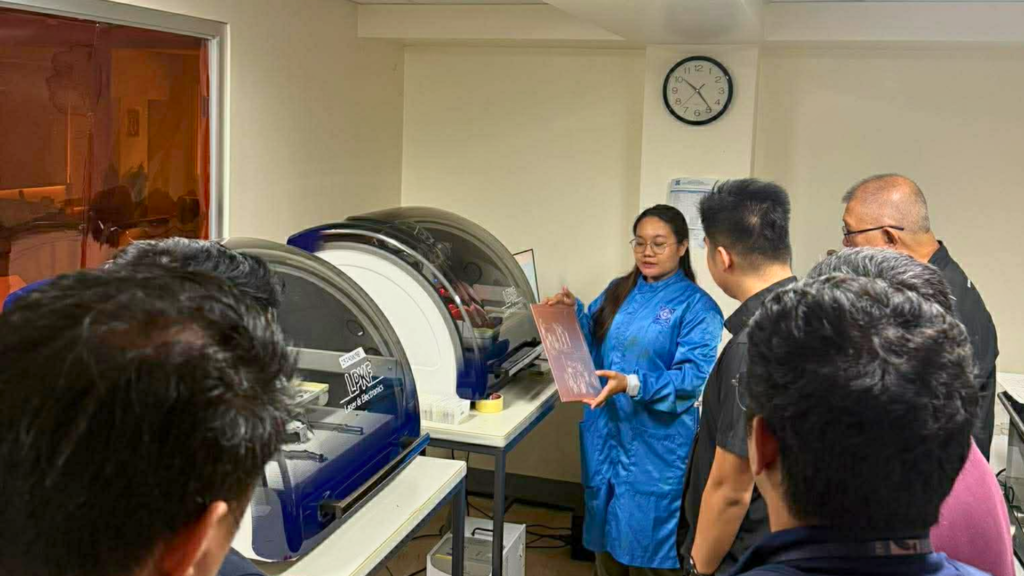


In a significant initiative towards strengthening academe–industry–government collaboration, faculty members from Rizal Technological University (RTU) College of Engineering (CEng) conducted an Exploratory Visit to the Department of Science and Technology (DOST)–Bicutan on February 4, 2025.
The exploratory visit provided RTU faculty members with valuable insights into DOST’s extensive research, development, and innovation infrastructure. The visit also facilitated constructive discussions on potential collaborative research, instructional enhancement, and technology development initiatives between DOST and the RTU College of Engineering, mediated by the Research Development and Innovation Office (RDIO).
The delegation represented various engineering disciplines of RTU and was composed of Engr. Joven M. Baltazar from the Electrical Engineering Department; Engr. Jayross Amar V. Amar from the Mechatronics Engineering Department; Engr. Jasper Mijares from the Mechanical Engineering Department; Engr. Alvin Dela Torre from the Civil Engineering Department, and Engr. Darius I. Trance from the Electronics Engineering Department and the Instrumentation & Control Engineering Department. The group was accompanied by University Researcher and former DOST Secretary Engr. Fortunato T. Dela Peña, whose participation further underscored the institutional relevance and strategic importance of the visit.
The exploratory activities began at the DOST–Electronics and Product Development Center, introducing RTU faculty members to advanced laboratory facilities supporting embedded systems engineering, printed circuit board (PCB) design and manufacturing, and specialized testing for electromagnetic compatibility and product safety. These facilities demonstrate the effective translation of research concepts into industry-compliant technologies.
The delegation also toured the Metal Industry Research and Development Center–Advanced Manufacturing Center, showcasing state-of-the-art additive manufacturing and 3D printing technologies currently applied across sectors such as manufacturing, healthcare, construction, and aerospace, underscoring the expanding role of advanced manufacturing in engineering research, innovation, and education.
The DOST–Industrial Technology Development Institute also introduced metrology and calibration facilities, underscoring the importance of precision measurement and standardization in engineering practice. The institute also discussed ongoing research and development initiatives in fuel cell technology and material recovery aligned with national priorities on sustainability, clean energy, and circular economy development.
Leveraging DOST’s advanced facilities, technical expertise, and research capabilities, the prospective collaborations aim to strengthen the academic instruction, expand research productivity, and promote innovation while ensuring alignment with national development goals and science and technology priorities.
The visit reaffirmed a shared institutional commitment in advancing engineering education beyond conventional classroom boundaries, fostering innovation, reinforcing research culture, and contributing to solutions for emerging societal and technological challenges through sustained collaboration between higher education institutions and national research agencies.